Let AI Teach Me · Against hallucination

This answer — should I check the source

Decide by the stakes. The smoother and more complete the answer, the more you should pull one claim and check it against the source.

The confirm page has one line: installment fee 0.6% per period. The full rules sit in the agreement link below — a dozen-plus pages. In the bank App you are splitting a 12,000-yuan laptop into 12 payments. You send that line to the AI and ask how much extra you pay in total, and whether prepaid settlement still charges the remaining fees.

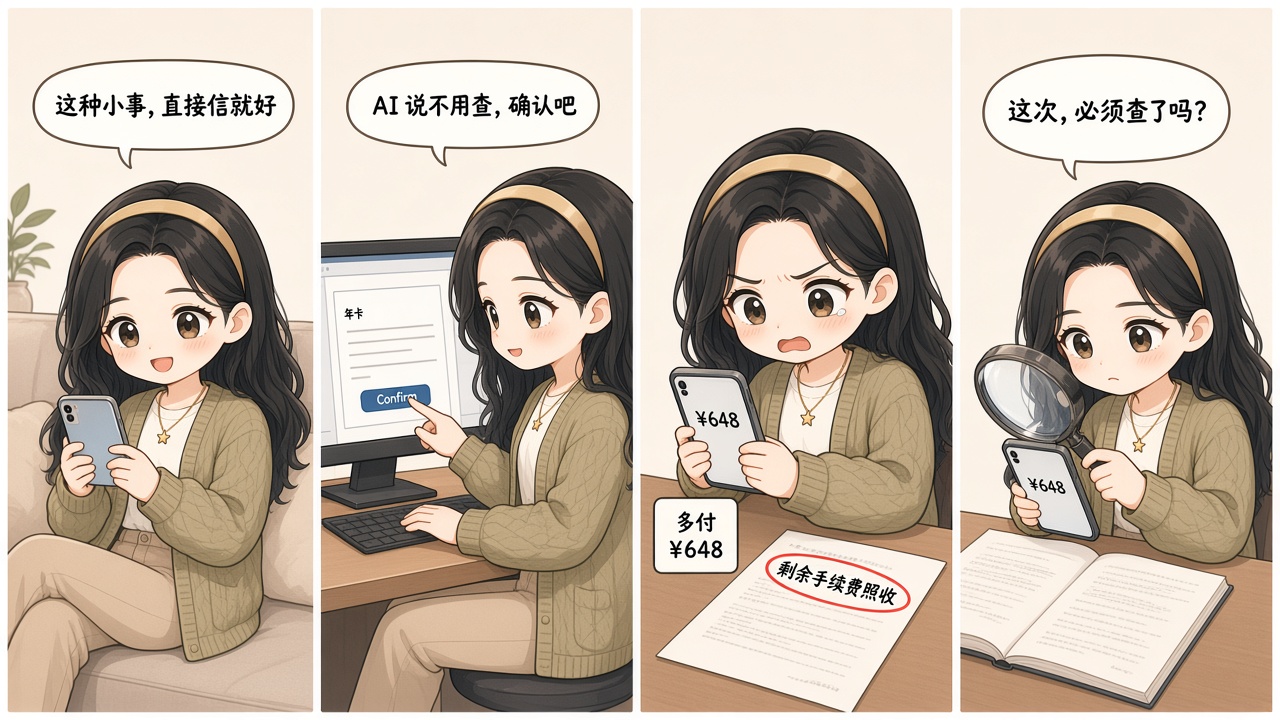
It gets 72 yuan per period, 864 yuan across 12, then adds: “After early settlement, remaining-period fees are no longer charged.” The multiplication checks out. The second half also matches the gut feel that borrowing for less time should cost less. You treat it as arithmetic — no need to open a dozen pages of agreement — and tap confirm.

Three months later the bonus lands and you settle early. The page charges 648 yuan on top of principal — exactly the remaining nine periods of fees. You go back to that chat. The AI gave a complete-looking rule, but no bank name, agreement version, or clause location. You open the agreement you skipped. It says:

On early settlement, fees already collected are not refunded, and remaining uncollected fees are charged in full on the settlement date.

That step got a pass because correct multiplication bought trust for the whole answer. 72 times 12 is 864. That only proves the math. How early settlement is charged depends on what this agreement says. Right math cannot testify for a rule with no source.

The AI can shrink the check to one or two sentences first

Keep asking “are you sure?” and you still get a generated result from the same chat. The AI is better at narrowing the range, so leaving the chat goes from “read a dozen pages” to these three steps:

  1. Circle the original sentence that would change the decision — here, “remaining fees are no longer charged.”
  2. Name the raw material you should open — here, the agreement for this installment product, not another bank’s support FAQ.
  3. Give the search words. Open the agreement, search “early settlement” and “remaining fees,” and read the two paragraphs around the hit.

One check like this only verifies one rule. Do that to every sentence while you study, and attention keeps getting yanked away. When can you stay in the chat and keep learning, and when should you go check the source right now? Below, slide use and smoothness together.

Try it first · Look at the use, then decide whether to leave the chat
Same installment answer — change the use, watch how you handle it
What are you going to do with this answer
How smooth does this answer read
The AI’s answer in the chat (demo)
Pick a use and a smoothness, or hit Play and watch it change.
What you should do with this answer now
Pick a scene for how you will use this answer.
First look at what you will do with this sentence.
Stakes did not change. The answer just reads smoother Smooth, complete, steady tone — that is how it generates. With a source or without, it can use the same voice.
Spot-check the specific claim most likely to get a free pass That opening line — “early settlement no longer charges remaining fees” — looks most complete, so take it to the agreement first.
Teaching demo: both answers and the numbers in them were written for this lesson. They do not match any bank’s rules.
When you see these signals, go check the source

Judge first by what happens if you get it wrong once, then by whether the answer made you drop your guard. The four items below can go back into the chat as a block, and let the AI draft the shortest check list.

Copy this whole block
  1. Find the sentences that would change an actionQuote, as written, the sentences above that would change how I pay, sign, submit materials, retell in public, or decide for someone else. Quote only. Do not explain first.
  2. Then write what one error costsFor each sentence: if it is wrong, what extra would I pay, what condition would I miss, what liability would I take, or who would follow me into the mistake. If you cannot name the cost, drop it to low priority.
  3. Name the raw material you actually have to openFor each sentence, point to the raw material and the exact spot: current agreement, official notice, a bill field, or raw data. Do not stop at a search result, a retelling, or another AI answer.
  4. Flag complete-sounding claims with no sourceAny sentence that sounds sure and complete, but has no locatable source, mark as “to-check.” If you cannot find a basis, leave the gap. Do not fill it from common practice.

Here the AI shortens the list. It cannot turn “to-check” into “already proven.” The last step is still leaving the chat and seeing the matching sentence in the raw material yourself.

Why the first gate looks at the stakes

If you just want a strange concept explained, one wrong sentence costs little. Stay in the chat, ask for sources, mark what is uncertain, and keep learning. Once the answer will enter a payment page, an application, a contract, or something public, the same sentence starts a real action, and the check jumps in priority.

Smoothness is the second signal. A hedged answer makes you pause. Complete numbers and rules slide through. The more an answer looks ready to use, the more you should pull one key claim and touch the source. That is about where to spend check energy, not a claim that a smooth answer is always wrong.

That opening installment only needs two checks: match 0.6% per period on the confirm page, then search “early settlement” in the current agreement. If the second check finds no support, leave “remaining fees are no longer charged” on the to-check list and hold confirm. Run the answer through three checks can narrow the range first. The source closes the last door.

This is a working habit for spending check energy by the stakes. There is no lab threshold behind it.

Smooth, complete, steady tone — none of that is evidence.