Let AI mark the five kinds of info it most likely invents
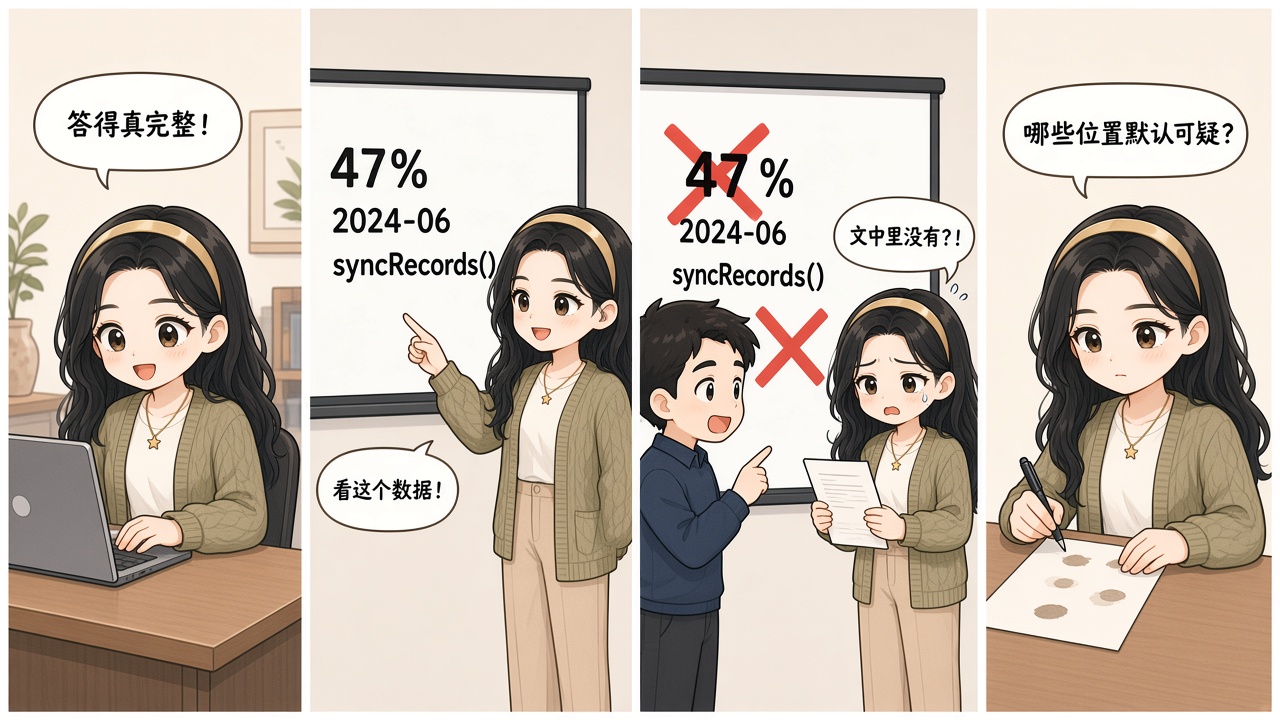
In a paragraph that reads smoothly, five spots should be suspect by default. When you're done, you can point to where they are.
The recycler comes at eleven for the old phone. You have forty minutes. Finger on factory reset, you remember the robot vacuum is bound to this phone — the map from half a year, the no-go zones, the cleaning history. Will they vanish with it. You hand AI the model name and that 32-page manual, and ask this one sentence.
It quickly returns a neatly lined-up reply:
Reply summary (teaching sketch): this model launched in 2019, dustbin 0.47 L. The app has a “Carpet Boost” setting. The care manual says replace the roller brush every 90 days. The device supports cloud sync — sign into the same account and the map, no-go zones, and cleaning history come back on their own.
Year, decimal, setting name, manual rule, feature conclusion — nothing missing, and the tone never hesitates. Cloud sync also matches what you know about connected appliances. You factory-reset the old phone and hand it over at 11:05.
That night you sign into the new phone. The device is there. The map is blank. The 6 no-go zones and 3 scheduled jobs you set never come back. The old phone is already gone. Until you remap, the robot can't clean the old rooms.
You believed it not because you skimmed. The concrete numbers, UI names, and firm conclusions all looked lifted from the manual. Those are also the details easiest to fill in on the fly. A steady tone, tidy format, and specific details don't prove the sentence came from the source.
AI keeps generating whatever looks most like an answer from the text in front of it. The manual says 0.47 L, it can repeat that. The manual never mentioned cloud sync, and it can still borrow a common design and fill the blank in the material with a plausible feature. Years, specs, and setting names also get format-correct candidates.
So step one isn't tearing down the whole answer, or checking every word. Circle these five spots first:
- Numbers, including capacity, ratios, version numbers, and thresholds.
- Timelines, including launch dates and feature-update dates.
- Settings, API names, and parameters. Names are easy to write so they look like a real UI.
- Details from obscure materials, where a second public text is hard to find.
- Whether a feature exists. If the material never mentioned it, the blank is easy to fill from experience.
These five don't mean they're wrong. They mean “don't copy them into your notes yet.”
AI can also help the other way: have it do one risk pass, pull the original sentences out item by item, then you decide which to check first. In that opening reply, which item is true, and which ones were just filled in to look true?
Next time you get a smooth answer, have AI lay the hot spots open first. Copy the three sentences below as a block. Swap the material for the reply you're reading.
- Circle the spots only, don't rewrite yet
Please check the reply below and excerpt five kinds of info as-is: numbers; timelines; settings, API names, or parameters; details from obscure sources; whether a feature exists. Don't rewrite the original, and don't judge whether the whole paragraph is reliable.
- Put every spot on one list
List them as “original sentence | which class | what goes wrong if it's false.” If one sentence belongs to two classes, mark both.
- Give the shortest check action
For each spot, only tell me which source to open and which section to look at. If you can't find a basis, write “still needs a check.” Don't fill in an answer from common sense.
You can put all three in one message. When the reply is long, paste one subsection at a time so the list is easier to finish.
In the first sentence, excerpt as-is is the key. Ask it only to summarize the risk and it may come back with “double-check the specs,” and you still don't know which words in the original to stare at. An as-is excerpt lays out “0.47 L,” “2019,” “supports cloud sync,” one by one.
In the third sentence, “if you can't find a basis, write still needs a check” is also the key. Without that half-sentence, AI may invent a page number while explaining its old answer. Write still-needs-a-check, and the list keeps the empty slot that isn't solved yet.
All five are usually short. Dropped into a sentence they look specific. Precision is easy to mistake for a source.
Capacity, thresholds, and percentages can all be filled with one value. A decimal point doesn't mean the number has a source.
Launch year and feature-update dates need a check against an announcement or a version log.
UI names have a fixed tone. A name that doesn't exist can still look like real product copy.
In-box manuals and old docs are rarely public. Errors are hard to bump into in time.
Materials rarely list, item by item, which features they don't have. The blank is easy to fill from common product experience.
That opening 0.47 L does match the spec page. 2019, Carpet Boost, replace every 90 days, cloud sync — no matching basis. Hot zones also hold true sentences, so after you circle them you still look at the cost and decide which to check first. Next: Three defenses and When to check the source.