Let AI explain it for my situation
Anchor, scene, a quiz, a warning — miss one, and the answer is missing a piece. Four template sentences you can copy and take.
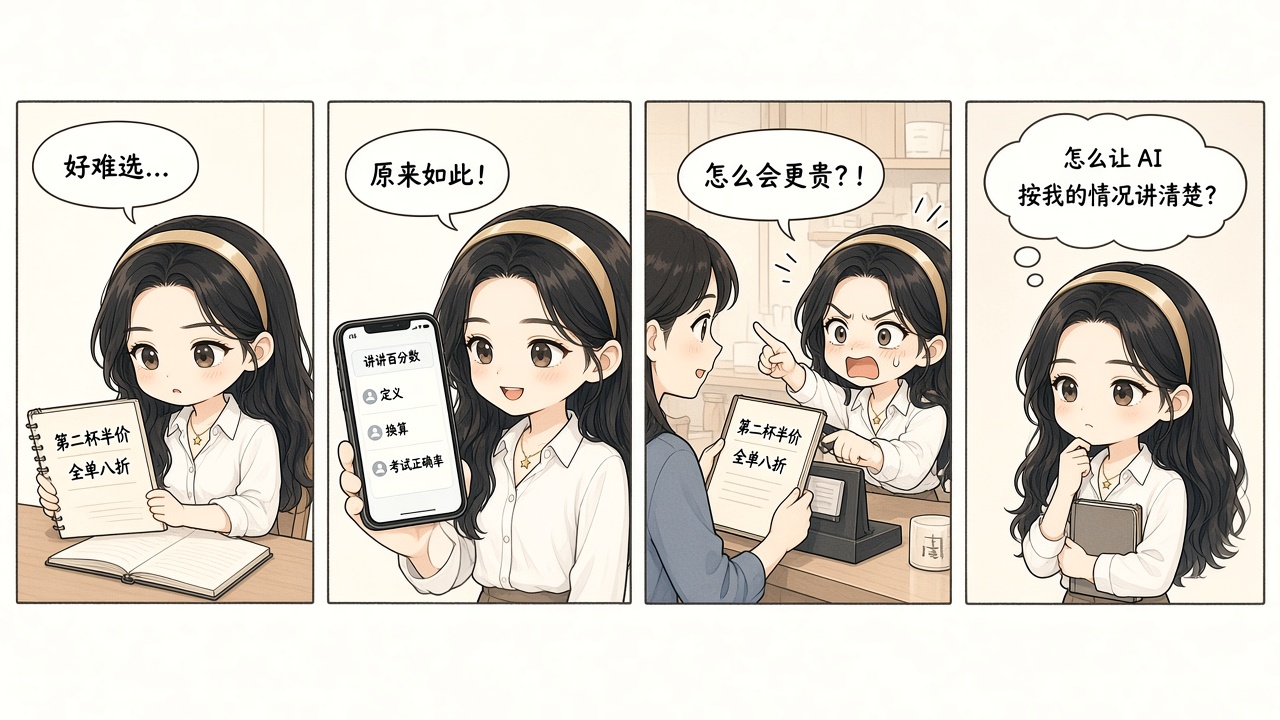
70% on the second item, or 85% on both. Two weekend deals sit side by side. You're picking storage boxes for the study. The two you want are ¥120 and ¥80.
You want percentages straight first, so you open AI and type a perfectly normal sentence.
Teach me percentages.
It goes from the definition of a percentage to converting decimals, and even uses exam scores as the example. Every step is readable. You see that 七折 is 70%, 八五折 is 85%, pick the smaller number, and figure that deal saves more.
Saturday 10:25 a.m., you check out. 70% on the second item is ¥176; 85% on both is ¥170. You overpay by ¥6, then notice 70% only lands on the ¥80 second item, while 85% lands on the ¥200 total.
Part of why you picked wrong sits in that question. It only said what to learn — not how far you already are, which bill you're about to run, how to check after the talk, or where you're most likely to mix things up. So AI delivered a lecture that covers the topic, and never touched the two price tags on your desk.
“Teach me percentages” only gave a topic. AI doesn't know you already convert decimals, so it starts from the definition. It doesn't know you want to compare two discounts, so the example goes to exam scores. It doesn't know you want to check whether you can calculate, so it stops when the lecture ends. And it doesn't know you'll compare the discount numbers directly, so it never flags the trap: the bases are different.
One extra sentence in the question adds one thing the answer must deliver. The four parts control where the answer starts, where the example lands, how you check after the talk, and which mix-ups to block early.
- First tell it how far you already are, so the answer can skip the recap and pick up from your starting point.
- Then write what you're going to use it for, so the example lands on two price tags and two discounts.
- Ask it to quiz you after the talk, so you have to calculate once yourself — smooth reading becomes an answer you can check.
- Ask it to flag easy mix-ups early, and it will remind you to find which price each discount multiplies.
How do those four sentences actually get written? Below, watch the same question: each part you add, see what extra piece the answer delivers.
The four sentences below can follow any study question. Swap the blanks for your content and send all four. On the discount problem just now, the whole block lands on your starting point and those two price tags.
- Tell AI your starting point
I already get: percentages and decimals convert into each other. Start from here. Skim the part I already know.
- Say the job you're doing
I'll use it to compare shopping discounts. Please use “two items at ¥120 and ¥80 — 70% on the second vs 85% on both, which saves more” as the example.
- Have it quiz you after the talk
After the talk, give me three questions. Change only one condition each time. Don't show answers until I reply one by one.
- Have it flag mix-ups early
Point out where I'm most likely to go wrong calculating discounts, especially whether each discount multiplies the second item, a single price, or the total.
When you change the material, only change what follows the blanks and the example in sentence two. Keep the four-step order.
In the first sentence, I already get sets the start. Write only “go into more detail,” and AI still has to guess your level — most often it lays the definition out again.
In the second sentence, I'll use it to pins where the example lands. Keep the two concrete prices too. “Use it for shopping” is still huge — AI may switch to spend-threshold deals, coupons, or points.
In the third sentence, don't show the answers yet holds the check. Without that half-sentence, AI often tucks the answer under the question, you keep reading the ready-made steps, and the chance to calculate yourself is gone again.
In the fourth sentence, which price each discount multiplies names the mix-up you worry about most. The more specific the warning, the easier it is for AI to stop that error before you calculate.
The four parts can be used alone. When time is tight, write the scene and the quiz first. The answer will at least stick to the problem in your hand, and leave one action you have to finish yourself. That's experience in how to write the question.
The analogy sentence has to come from you — see Let AI analogize with something I already know. To make it hand the next thinking step back, see Let AI ask me one question at a time. Taking it out as its own action has a page: Close the material and let AI quiz me.